
Thursday, November 24, 2011


Saturday, November 19, 2011
Newest work
Both of my parents just celebrated their birthdays at the end of October so I made each of them a needle-felted animal (of course). For my dad I made a Japanese macaque. I had him eating a sweet potato because I like the fact that these monkeys like to dip sweet potatoes in the ocean to wash and season them before eating them. I made my mom a Jersey cow because she was born on the year of the cow in the Chinese zodiac and she's always liked cows. The very professional looking studio photos of the monkey are courtesy of my friend Kelty of steepstreet.com


Sunday, November 6, 2011
Food! From our farm!
On Thursday we took our first batch of birds to the slaughterhouse. 25 of our ducks and 16 of our roosters. So that leaves us with 5 ducks: 1 drake and 4 females, and 26 chickens: 1 rooster and 25 pullets. We learned a couple valuable lessons on that day. First of all dual purpose heritage breed chickens do not grow fast enough to reach a good slaughter weight in 3 months and secondly, neither do Rouen ducks. Suffice it to say, our chickens and ducks came back looking a little small. The chicken carcasses were about 2lbs so they will make good fryers and the duck carcasses were about 3lbs. Next time we plan to raise a chicken breed that was meant for meat production. We will probably stick with the Rouen ducks but raise them for at least another month. The good news is, we had one of the chickens for dinner Friday night and it tasted delicious.
We were however very happy with the slaughterhouse itself. It's a very small operation run by an Amish family, and the waiting area has a large window that allows customers to see everything that goes on. Nevertheless I felt terribly guilty dropping our birds off to be slaughtered after having cared for them from the time they were less than 2 days old. But I just have to remind myself that they had very happy lives and they died for a good cause: feeding people in a healthy way that is not harmful to the environment.


We were however very happy with the slaughterhouse itself. It's a very small operation run by an Amish family, and the waiting area has a large window that allows customers to see everything that goes on. Nevertheless I felt terribly guilty dropping our birds off to be slaughtered after having cared for them from the time they were less than 2 days old. But I just have to remind myself that they had very happy lives and they died for a good cause: feeding people in a healthy way that is not harmful to the environment.


Tuesday, October 25, 2011
Real farming 101
Last week was another busy one for us on the farm. The Harms' tenant farmer had just finished harvesting the corn off of the land around our house so we could finally start prepping our 10 acres for next year. Out of these ten acres we will be using 6 acres for pasture and 4 for vegetable fields.
Our original plan was to cover crop all 10 acres with rye and vetch to build up the organic matter and nutrients in the soil and let the root growth alleviate some of the soil compaction. However since the corn did not get harvested until the middle of October we didn't want to take the risk of having all 10 acres of cover crop fail to germinate due to cold weather. So we decided to plant just the 4 acres we will be using for vegetable fields.
Of course none of this went according to plan. First we couldn't find nearly enough rye seed to cover 4 acres. We needed 200lbs but ended up with only 125. Because of this we could only seed 2 acres.
Next we needed a manure spreader to spread some compost we had purchased from our neighbors' dairy farm. Amazingly, our neighbors at South Pork Ranch happened to have one taking up space on their farm so they just told us we could have it! We were excited to use it so we filled it up and drove it out to the field. But as soon as we fired up the tractor's PTO (power take off) a vital piece of the spreader just fell off. So much for spreading compost. Next we used Mr. Harms' tractor and disc harrow to cut up the corn stalks and till the field. That went smoothly but there was so much crop residue on top of the field that running the disc over it a couple times did not expose much soil. For the final step of seeding the rye and vetch the plan was for us to use a couple of push seeders that we got for cheap at the Champaign Habitat for Humanity store. As soon as we pushed them out onto the field we realized that wasn't going to happen. The terrain was just too rough for the seeders to work properly. So Emma and I spent the whole morning walking back and forth across our 2 acre field, tossing seeds out of a bucket. Now we just hope the seeds actually manage to grow in spite of all the crop residue and the cold, having been planted so late in the fall.
Our original plan was to cover crop all 10 acres with rye and vetch to build up the organic matter and nutrients in the soil and let the root growth alleviate some of the soil compaction. However since the corn did not get harvested until the middle of October we didn't want to take the risk of having all 10 acres of cover crop fail to germinate due to cold weather. So we decided to plant just the 4 acres we will be using for vegetable fields.
Of course none of this went according to plan. First we couldn't find nearly enough rye seed to cover 4 acres. We needed 200lbs but ended up with only 125. Because of this we could only seed 2 acres.
Next we needed a manure spreader to spread some compost we had purchased from our neighbors' dairy farm. Amazingly, our neighbors at South Pork Ranch happened to have one taking up space on their farm so they just told us we could have it! We were excited to use it so we filled it up and drove it out to the field. But as soon as we fired up the tractor's PTO (power take off) a vital piece of the spreader just fell off. So much for spreading compost. Next we used Mr. Harms' tractor and disc harrow to cut up the corn stalks and till the field. That went smoothly but there was so much crop residue on top of the field that running the disc over it a couple times did not expose much soil. For the final step of seeding the rye and vetch the plan was for us to use a couple of push seeders that we got for cheap at the Champaign Habitat for Humanity store. As soon as we pushed them out onto the field we realized that wasn't going to happen. The terrain was just too rough for the seeders to work properly. So Emma and I spent the whole morning walking back and forth across our 2 acre field, tossing seeds out of a bucket. Now we just hope the seeds actually manage to grow in spite of all the crop residue and the cold, having been planted so late in the fall.
 |
| Emma discing in the corn stalks with Mr. Harms' tractor and disc harrow |
 |
| Rye and vetch seeds |
 |
| Seeding our cover crops |
Wednesday, October 5, 2011
Making hay with Mr. Harms
Yesterday evening we finished making our first batch of hay! But we could not have done it without the help of our next door neighbor and landlord's father, Herman Harms. He has generously given us the use of his barn, his tractor and the 5 acres of pasture around his farmhouse free of charge. Even more importantly he has been a constant source of help and advice since we first arrived here in July. He has farmed this land ever since he returned home from serving in World War II, so it's safe to say he knows a thing or two about farming.
We decided last week to make hay out of the approximately 1 acre pasture behind Mr. Harms' barn because the weather forecast looked good and the grass was nice and tall. On Friday we cut the grass using the side mounted sickle bar mower on our Allis Chalmers C tractor. At first the bar kept getting clogged up but Mr. Harms helped us figure out how to adjust the height of the sickle bar so that it would cut smoothly. On Saturday afternoon we used Mr. Harms' side delivery rake to rake the hay into windrows (linear piles), flipping the hay over so that it would dry evenly. Then we flipped the windrows over on Sunday speed up the curing process. On Monday afternoon, as suggested by Mr. Harms, we consolidated the windrows into several large piles in order to make collecting the hay a lot quicker and easier. In spite of our protests Mr. Harms insisted on picking up a hay fork and helping us with this. Then that same evening we began collecting the hay. Mr. Harms pulled a flatbed trailer around the field with his tractor while Emma and I forked the hay. We got half of it done on Monday and finished the second half on Tuesday. We ended up with so much hay that it takes up almost half of the first floor of Mr. Harms barn, piled almost to the ceiling.
We decided last week to make hay out of the approximately 1 acre pasture behind Mr. Harms' barn because the weather forecast looked good and the grass was nice and tall. On Friday we cut the grass using the side mounted sickle bar mower on our Allis Chalmers C tractor. At first the bar kept getting clogged up but Mr. Harms helped us figure out how to adjust the height of the sickle bar so that it would cut smoothly. On Saturday afternoon we used Mr. Harms' side delivery rake to rake the hay into windrows (linear piles), flipping the hay over so that it would dry evenly. Then we flipped the windrows over on Sunday speed up the curing process. On Monday afternoon, as suggested by Mr. Harms, we consolidated the windrows into several large piles in order to make collecting the hay a lot quicker and easier. In spite of our protests Mr. Harms insisted on picking up a hay fork and helping us with this. Then that same evening we began collecting the hay. Mr. Harms pulled a flatbed trailer around the field with his tractor while Emma and I forked the hay. We got half of it done on Monday and finished the second half on Tuesday. We ended up with so much hay that it takes up almost half of the first floor of Mr. Harms barn, piled almost to the ceiling.
 |
| Emma making windrows |
 |
| Mr Harms and Emma raking hay |
 |
| Emma and Mr Harms harvesting hay |
Wednesday, September 28, 2011
Casualties
The last couple of weeks have been a bit traumatic for our poor chickens. We lost nine of them to various predators. Five of the casualties we never found any trace of, which probably means they were taken away by a hawk. The rest were left headless by either a skunk or a weasel (they like to just eat the heads and drink the blood). This week we are trying to keep Adzuki outside with them as much as possible and that seems to be helping so far.
Our sheep meanwhile are doing very well. The first few days after we brought them to our farm they were scared of us but we've managed to win their love through bribery, using treats of grain and tree branches full of delicious leaves (for some reason their favorite food in the world seems to be trees of any type). Now they come running to greet us and follow us around their paddock.


I'm still keeping busy with my needle-felting. I've been doing a lot of dog portraits lately as you can see:


Our sheep meanwhile are doing very well. The first few days after we brought them to our farm they were scared of us but we've managed to win their love through bribery, using treats of grain and tree branches full of delicious leaves (for some reason their favorite food in the world seems to be trees of any type). Now they come running to greet us and follow us around their paddock.


 |
| Our ram, who we've decided to name Heimdal, after the guardian of the gods from Norse mythology. (Thanks Adam for the suggestion!) |
I'm still keeping busy with my needle-felting. I've been doing a lot of dog portraits lately as you can see:

 |
| An enormous Tibetan mastiff named Cider |


Thursday, September 8, 2011
We have Sheep!
Today Emma and I drove out to Red Brick Road Farm to pick up our sheep. It had to be the most beautiful farm we had ever seen. The sheep were free to roam around a large area encompassing a small patch of forest, a beautiful creek and an expansive pasture.
So we now have 6 sheep: 1 ram lamb, 3 ewe lambs, and 2 adult ewes. They are all Icelandics, one of the most ancient breeds of domestic sheep in the world. They've been around for 1100 years!
 our young ram


 do you think it's safe?


So we now have 6 sheep: 1 ram lamb, 3 ewe lambs, and 2 adult ewes. They are all Icelandics, one of the most ancient breeds of domestic sheep in the world. They've been around for 1100 years!


mutual suspicion
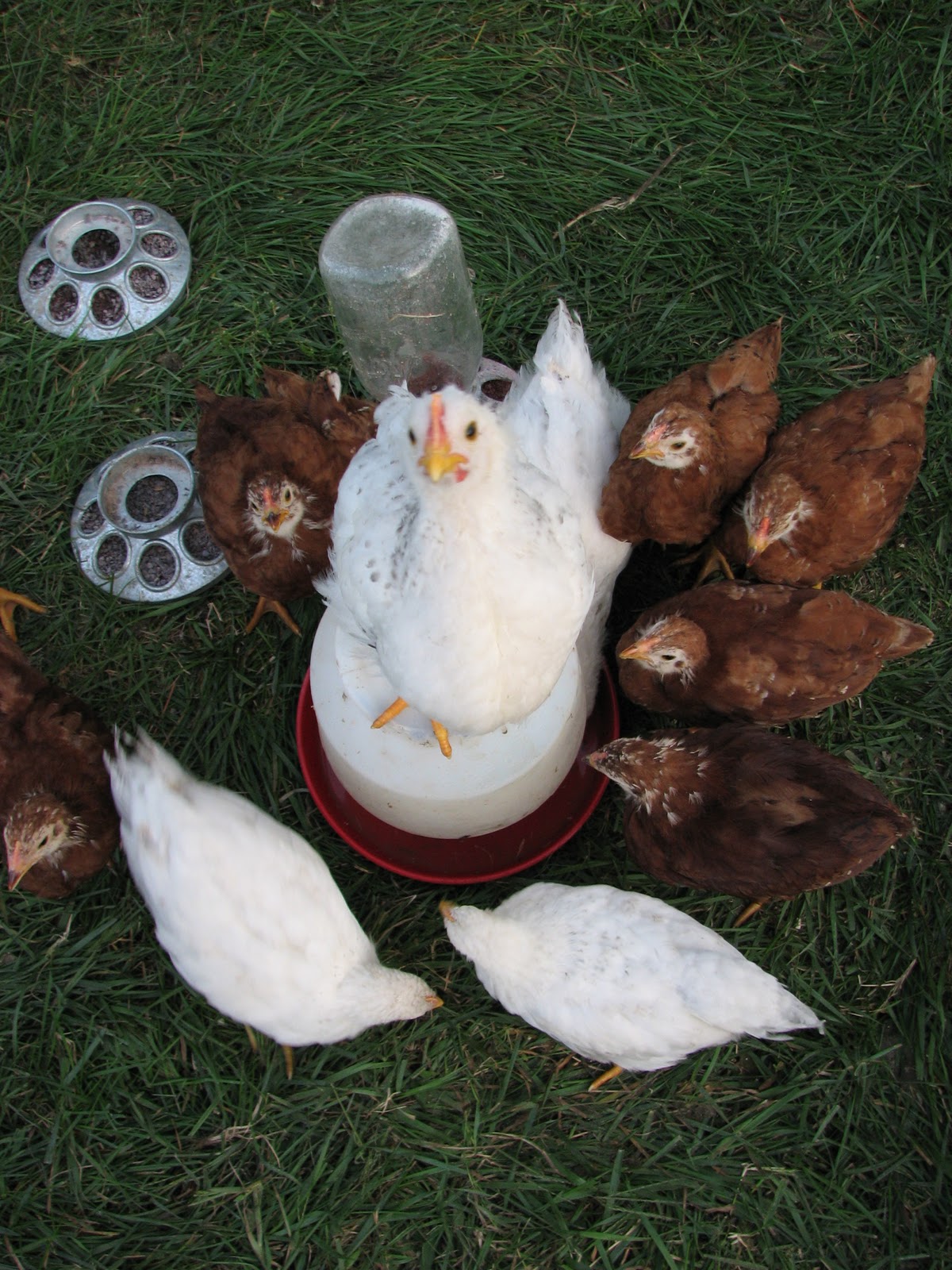
So far this week has been an extremely busy one for our farm. Aside from preparing for the arrival of our sheep, Emma and I built another mobile coop for our chickens, ground hundreds of pounds of chicken/duck feed and on Friday we moved the chicks out to join the ducklings on pasture.


Subscribe to:
Posts (Atom)


